


.thumb.png.5e36167c778c6f4735f0d20d15288e59.png)
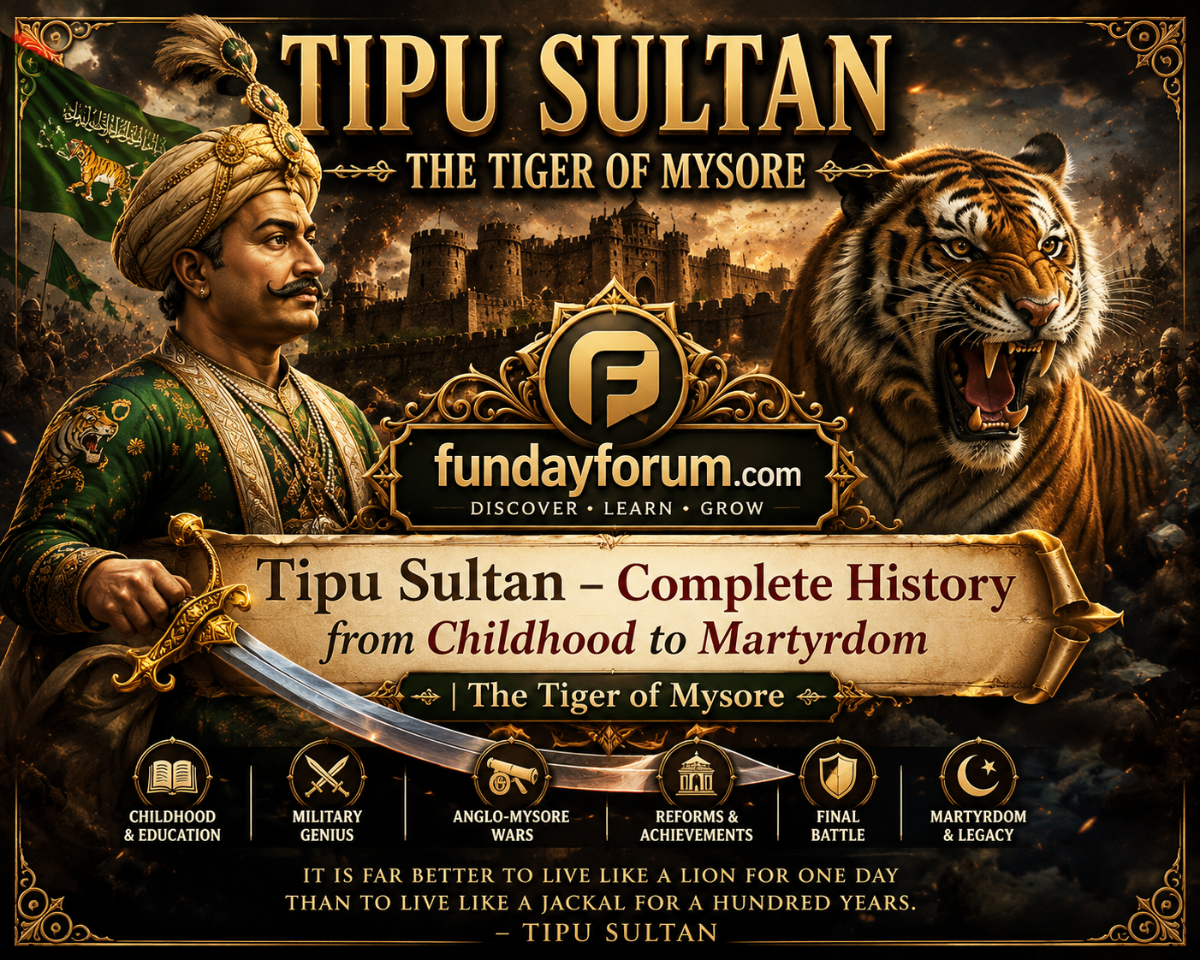
Tipu Sultan (1751–1799) – Complete History from Childhood to Martyrdom
Introduction
Tipu Sultan, famously known as the Tiger of Mysore, was one of the most powerful rulers in Indian history. He is remembered for his bravery, military innovations, resistance against British colonial expansion, and efforts to modernize his kingdom. His life was filled with battles, political challenges, diplomatic achievements, and sacrifices that made him a legendary figure in South Asian history.
Tipu Sultan's famous saying:
"It is far better to live like a lion for one day than to live like a jackal for a hundred years."
Birth and Family Background
Tipu Sultan was born on 20 November 1750 in Devanahalli.
His Parents
-
Father: Hyder Ali
-
Mother: Fatima Fakhr-un-Nisa
His father, Hyder Ali, rose from a military commander to become the ruler of the Kingdom of Mysore.
Childhood and Education
From an early age, Tipu Sultan received excellent education.
Subjects He Studied
-
Arabic
-
Persian
-
Urdu
-
Islamic Studies
-
Mathematics
-
Military Science
-
Administration
-
Diplomacy
He was known for his intelligence, discipline, and strong memory.
Military Training
His father believed that a future ruler must be a skilled warrior.
Tipu learned:
-
Horse riding
-
Sword fighting
-
Archery
-
Military tactics
-
Battlefield leadership
By the age of fifteen, he was already accompanying his father in military campaigns.
Early Military Career
In his teenage years, Tipu fought alongside his father against various enemies.
First Experiences in Battle
He gained experience against:
-
Maratha forces
-
Nizam of Hyderabad
-
British East India Company
His courage impressed both allies and enemies.
The First Anglo-Mysore War (1767–1769)
During this conflict, Tipu Sultan demonstrated exceptional leadership.
Achievements
-
Led successful military operations.
-
Protected Mysore territories.
-
Helped defeat British forces in several engagements.
The war ended with the Treaty of Madras.
Rise as Crown Prince
As Hyder Ali's most capable son, Tipu became the heir to the Mysore throne.
He actively participated in:
-
State administration
-
Tax reforms
-
Military planning
-
Foreign relations
The Second Anglo-Mysore War (1780–1784)
This war became one of the most significant conflicts against British expansion.
Battle of Pollilur (1780)
One of the greatest victories in Indian military history.
Tipu Sultan and Hyder Ali defeated a major British force.
Use of Rockets
Mysore became famous for:
-
Iron-cased rockets
-
Advanced artillery
-
Modern military technology
These rockets later inspired British rocket development.
Becoming Sultan of Mysore
In 1782, Hyder Ali died.
Tipu Sultan officially became the ruler of Mysore.
Coronation
He assumed full control of:
-
Government
-
Military
-
Economy
-
Foreign affairs
Administrative Reforms
Tipu Sultan was not only a warrior but also a reformer.
Economic Reforms
He introduced:
-
New coinage
-
Better taxation systems
-
State-controlled trade
Agriculture
-
Encouraged irrigation projects
-
Improved farming methods
-
Supported farmers
Trade
He established commercial relations with:
-
Ottoman Empire
-
Persia
-
Afghanistan
-
France
-
Arabia
Scientific and Technological Innovations
Tipu Sultan promoted:
-
Military engineering
-
Rocket technology
-
Manufacturing
-
International trade
His military rockets were among the most advanced weapons of the eighteenth century.
Relations with France
Tipu sought alliances with:
France
He hoped French support would help stop British expansion.
This alliance worried the British greatly.
The Third Anglo-Mysore War (1790–1792)
British forces formed alliances against Mysore.
Main Opponents
-
British East India Company
-
Maratha Confederacy
-
Nizam of Hyderabad
Despite fierce resistance, Tipu Sultan faced heavy pressure.
Treaty of Seringapatam (1792)
He was forced to:
-
Give up territory
-
Pay indemnities
-
Surrender two sons as hostages temporarily
The event was deeply painful for him.
Preparation for Future Resistance
After 1792, Tipu focused on:
-
Rebuilding the army
-
Strengthening forts
-
Improving administration
-
Expanding weapon production
He refused to submit to British control.
The Fourth Anglo-Mysore War (1799)
This became the final chapter of his life.
British forces launched a major invasion of Mysore.
Siege of Seringapatam
The capital city was surrounded.
Tipu Sultan personally led the defense.
Despite being outnumbered, he refused to surrender.
Martyrdom of Tipu Sultan
Date of Death
4 May 1799
Final Battle
During the storming of Seringapatam Fort, Tipu Sultan fought bravely until his last moments.
He was killed defending his kingdom.
His body was later found near the fort gate.
Famous Legacy
His resistance became a symbol of freedom and courage throughout South Asia.
Character and Personality
Tipu Sultan was known for:
-
Courage
-
Intelligence
-
Determination
-
Leadership
-
Patriotism
Supporters remember him as a defender of independence.
Legacy
Today, Tipu Sultan remains one of the most discussed historical figures in South Asia.
He is remembered for:
-
Fighting British colonialism
-
Military innovation
-
Administrative reforms
-
Economic modernization
-
Rocket technology development
Conclusion
Tipu Sultan's life was a story of bravery, leadership, and resistance. From his childhood under the guidance of Hyder Ali to his final stand at Seringapatam, he dedicated his life to protecting Mysore and resisting foreign domination. More than two centuries after his death, the Tiger of Mysore continues to inspire historians, leaders, and freedom lovers around the world.
















![More information about "[Dark / Light] Fluent Design Theme Edition"](https://fundayforum.com/uploads/monthly_2022_10/1.thumb.png.2ade2c3bae599c8d90ce20980a1e1307.png)




















Recommended Comments
There are no comments to display.
Join the conversation
You can post now and register later. If you have an account, sign in now to post with your account.
Note: Your post will require moderator approval before it will be visible.