


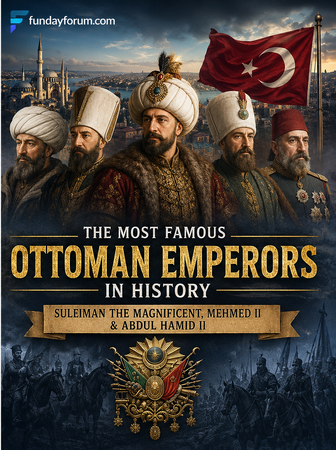
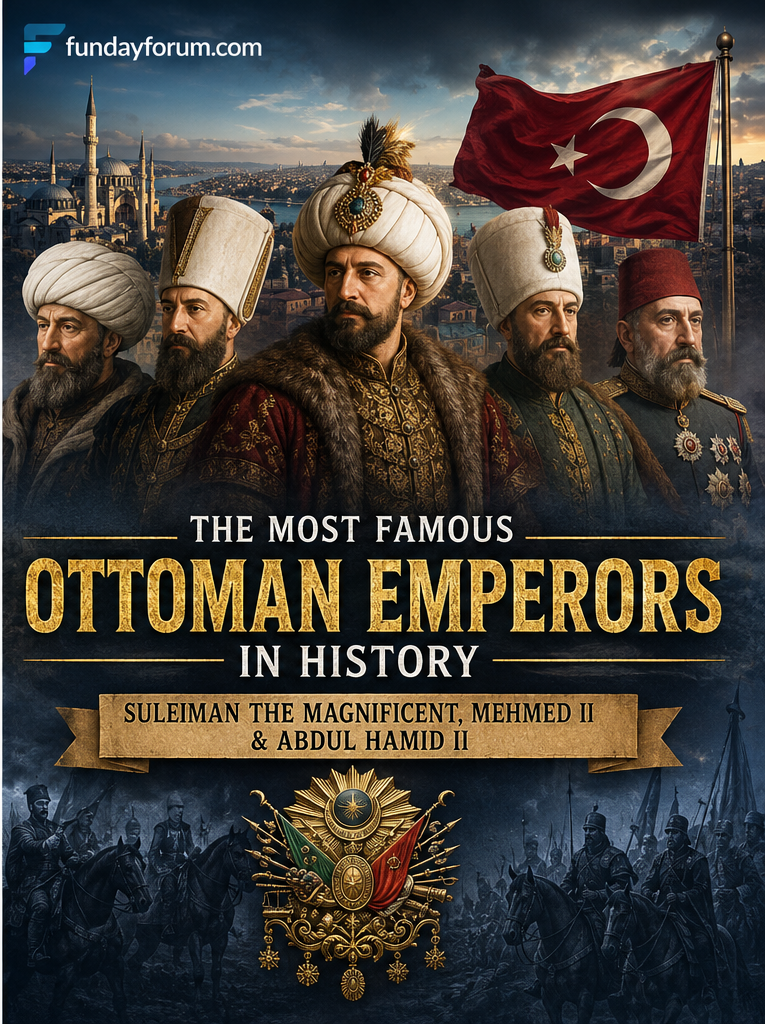
The Most Famous Ottoman Emperors in History: From Osman Ghazi to Sultan Suleiman the Magnificent
Introduction
The Ottoman Empire was one of the greatest and longest-lasting empires in world history. Founded in 1299 by Osman Ghazi, it ruled vast territories across Europe, Asia, and Africa for more than six centuries. At its height, the empire became a global power, influencing politics, culture, trade, architecture, and Islamic civilization.
Throughout its history, several Ottoman sultans left an unforgettable mark on the world. Some were brilliant military commanders, others were visionary statesmen, while a few became symbols of Islamic leadership and resistance. This article explores the most famous Ottoman emperors and their remarkable achievements.
1. Sultan Osman I (Osman Ghazi) (1258–1326)
Founder of the Ottoman Empire
Sultan Osman I, commonly known as Osman Ghazi, founded the Ottoman Empire in 1299. What began as a small Turkish principality in Anatolia eventually grew into one of the most powerful empires in history.
Key Achievements
-
Established the Ottoman State.
-
Expanded territory at the expense of the Byzantine Empire.
-
Created the foundations of Ottoman governance and military organization.
-
Inspired future generations of Ottoman rulers.
The name "Ottoman" is derived from "Osman," honoring the empire's founder.
2. Sultan Mehmed II (Muhammad Al-Fatih) (1432–1481)
The Conqueror of Constantinople
Sultan Mehmed II is one of the most celebrated figures in Islamic and world history. At just 21 years old, he achieved what many rulers had failed to do for centuries: the conquest of Constantinople in 1453.
The fall of Constantinople ended the Byzantine Empire and transformed the city into Istanbul, the new capital of the Ottoman Empire.
Key Achievements
-
Captured Constantinople in 1453.
-
Ended the Byzantine Empire.
-
Expanded Ottoman territories in Europe and the Balkans.
-
Modernized military tactics and artillery warfare.
-
Turned Istanbul into a major political and cultural center.
His victory is often regarded as one of the greatest military achievements of all time.
3. Sultan Selim I (1470–1520)
Expander of the Islamic Empire
Sultan Selim I, also known as Selim the Grim, dramatically expanded Ottoman influence across the Middle East.
Key Achievements
-
Defeated the Mamluk Sultanate.
-
Conquered Egypt, Syria, and the Hejaz region.
-
Brought the holy cities of Makkah and Madinah under Ottoman protection.
-
Strengthened Ottoman authority throughout the Muslim world.
His reign transformed the Ottoman Empire into the leading power of the Islamic world.
4. Sultan Suleiman the Magnificent (1494–1566)
The Greatest Ottoman Emperor
Many historians consider Sultan Suleiman the Magnificent to be the greatest ruler in Ottoman history. Known in the Muslim world as Suleiman the Lawgiver (Kanuni), he led the empire during its Golden Age.
Key Achievements
-
Expanded the empire to its greatest territorial extent.
-
Conquered Belgrade, Rhodes, and large parts of Hungary.
-
Reformed the legal and administrative system.
-
Strengthened trade and economic growth.
-
Sponsored architecture, literature, and the arts.
The Golden Age of the Ottoman Empire
Under Suleiman's leadership, the empire became one of the world's most powerful states. His era witnessed remarkable achievements in architecture, education, law, science, and military power.
For this reason, he is widely regarded as the most famous and influential Ottoman emperor.
5. Sultan Abdul Hamid II (1842–1918)
The Last Great Ottoman Sultan
Sultan Abdul Hamid II ruled during one of the most challenging periods in Ottoman history. Despite increasing foreign pressure and internal challenges, he worked tirelessly to preserve the empire.
Key Achievements
-
Promoted Pan-Islamic unity among Muslims worldwide.
-
Expanded educational institutions and communication networks.
-
Initiated the famous Hejaz Railway project.
-
Defended Ottoman sovereignty against European intervention.
Today, Abdul Hamid II remains a respected figure among many Muslims for his efforts to protect the empire and maintain Islamic unity.
Ranking the Most Famous Ottoman Emperors
Historical Fame Ranking
🥇 Sultan Suleiman the Magnificent
🥈 Sultan Mehmed II (Muhammad Al-Fatih)
🥉 Sultan Abdul Hamid II
🏅 Sultan Selim I
🏅 Sultan Osman I
While Sultan Suleiman is generally regarded as the greatest Ottoman ruler, Sultan Mehmed II is remembered for his historic conquest of Constantinople, and Sultan Abdul Hamid II remains admired for his defense of the Muslim world during the empire's final years.
Legacy of the Ottoman Empire
The Ottoman Empire shaped the history of three continents and left behind a rich legacy of architecture, law, culture, trade, and governance. From the founding vision of Osman Ghazi to the military brilliance of Mehmed II and the golden age under Suleiman the Magnificent, the empire's influence can still be seen today.
More than a political power, the Ottoman Empire became one of the most significant civilizations in world history, leaving an enduring impact that continues to fascinate historians and readers alike.

















![More information about "[Dark / Light] Fluent Design Theme Edition"](https://fundayforum.com/uploads/monthly_2022_10/1.thumb.png.2ade2c3bae599c8d90ce20980a1e1307.png)





















Recommended Comments
There are no comments to display.
Join the conversation
You can post now and register later. If you have an account, sign in now to post with your account.
Note: Your post will require moderator approval before it will be visible.