



The Surprising History of “OK” – How a Simple Joke Became the World’s Most Famous Word
Introduction
The word “OK” (or “okay”) is one of the most commonly spoken and written words in human history. It is used every day in conversations, text messages, business meetings, social media, and even official documents across the globe.
But surprisingly, this universal word did not begin as a serious term at all. Its origin traces back to a humorous joke created by newspaper editors in the United States during the nineteenth century.
What started as a playful abbreviation eventually transformed into one of the most recognized words in the world. Today, “OK” is understood in almost every country regardless of language or culture.
In this article, we explore the fascinating history, meaning, popularity, myths, and modern usage of the word “OK.”
Where and When Did “OK” Begin?
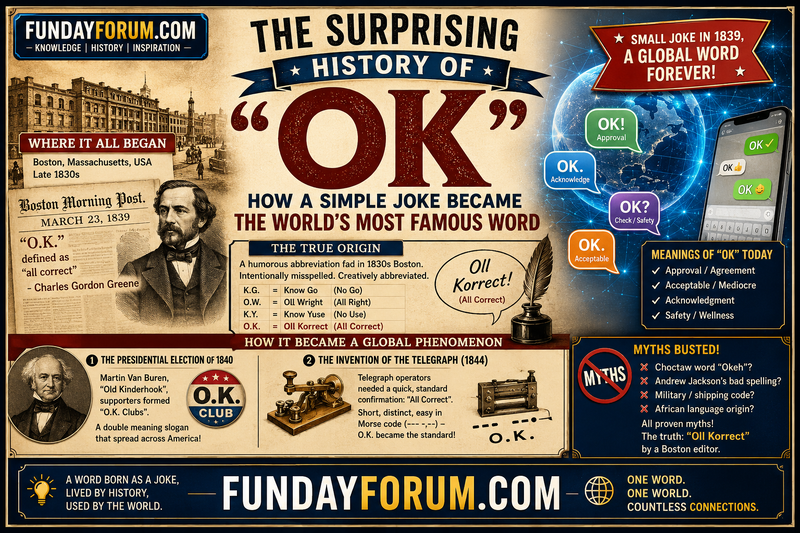
The word “OK” was born in Boston, Massachusetts, USA, during the late 1830s.
Its first known appearance in print was on March 23, 1839, in a famous newspaper called the Boston Morning Post.
At that time, newspaper editors often created humorous abbreviations and playful slang for entertainment purposes.
Who Created the Word “OK”?
The term was introduced by Charles Gordon Greene, editor of the Boston Morning Post.
Greene used the abbreviation “O.K.” while writing a satirical article criticizing a rival newspaper in Providence, Rhode Island.
Inside the article, he jokingly used the phrase:
“Oll Korrect”
(A humorous misspelling of “All Correct”)
He then shortened it to:
O.K.
This small joke unexpectedly became one of the most influential words in modern communication.
The 1830s Abbreviation Trend
To understand why “OK” became popular, it is important to understand the culture of Boston during the 1830s.
Educated young people and newspaper writers were obsessed with creating funny abbreviations and intentionally misspelled phrases — similar to how people today use internet slang such as:
- LOL
- OMG
- BRB
- IDK
The humor came from deliberately spelling words incorrectly and then shortening them into abbreviations.
Examples of Popular 1830s Slang
| Abbreviation | Funny Spelling | Real Meaning |
|---|---|---|
| K.G. | Know Go | No Go |
| O.W. | Oll Wright | All Right |
| K.Y. | Know Yuse | No Use |
| O.K. | Oll Korrect | All Correct |
Most of these slang terms disappeared over time, but “OK” survived and eventually conquered the world.
How Did “OK” Become Globally Popular?
Two major historical events helped transform “OK” from a local joke into an internationally recognized word.
1. The U.S. Presidential Election of 1840
Only one year after “OK” was invented, American President Martin Van Buren ran for re-election.
Van Buren was born in Kinderhook, New York, which gave him the nickname:
“Old Kinderhook”
His supporters created political groups called:
“O.K. Clubs”
The slogan worked perfectly because it had a double meaning:
- Old Kinderhook
- Oll Korrect (All Correct)
This political campaign spread the term “OK” throughout the United States.
2. The Invention of the Telegraph
In 1844, the telegraph revolutionized communication.
Telegraph operators needed a short and efficient way to confirm that messages were received correctly.
Because “OK” was:
- Short
- Easy to understand
- Quick to transmit
- Simple in Morse code
It became the standard confirmation signal for telegraph and railroad communication systems.
This permanently secured the word “OK” in business and everyday language.
Modern Meanings of “OK”
Today, “OK” serves several purposes in the English language depending on context.
1. Approval or Permission
Example:
“The manager gave the OK for the project.”
2. Acceptable or Average
Example:
“The movie was OK.”
Meaning it was neither amazing nor terrible.
3. Acknowledgment
Example:
“OK, I understand.”
4. Safety or Wellness
Example:
“Are you OK after the accident?”
Famous Myths About the Origin of “OK”
For many decades, the real origin of “OK” was forgotten, leading to numerous false theories and myths.
In the 1960s, linguist Allen Walker Read carefully researched thousands of old newspapers and finally proved that “OK” truly came from “Oll Korrect.”
Popular False Theories Included:
- Choctaw Native American Word “Okeh” – Meaning “it is so.”
- Andrew Jackson’s Spelling Mistake – Some claimed the president wrote “O.K.” instead of “All Correct.”
- Military and Shipping Codes – Others believed it came from transportation or army abbreviations.
- African Language Origins – Some linked it to words brought to America during the slave trade.
Although these stories became popular, historical evidence confirmed that the true origin was simply a humorous newspaper joke.
Why “OK” Became So Powerful
The success of “OK” happened because it is:
- Extremely short
- Easy to pronounce
- Easy to write
- Universally understandable
- Useful in almost every situation
Very few words in history have crossed language barriers as successfully as “OK.”
“OK” in Modern Digital Culture
Today, “OK” is deeply connected with internet culture and digital communication.
It appears everywhere:
- Text messages
- Emails
- Social media
- Business communication
- Smartphones
- Software systems
- Voice assistants
Even modern technology devices use “OK” as a universal command or confirmation word.
Conclusion
The story of “OK” proves that even a simple joke can change global language forever.
What began in a Boston newspaper in 1839 as a funny abbreviation eventually became one of the most recognized and widely used words in human history.
From politics and telegraphs to smartphones and Artificial Intelligence, “OK” has survived every generation and continues to remain part of daily communication worldwide.
More than just a word, “OK” is now a universal symbol of understanding, approval, and human connection.

















![More information about "[Dark / Light] Fluent Design Theme Edition"](https://fundayforum.com/uploads/monthly_2022_10/1.thumb.png.2ade2c3bae599c8d90ce20980a1e1307.png)





















Recommended Comments
There are no comments to display.
Join the conversation
You can post now and register later. If you have an account, sign in now to post with your account.
Note: Your post will require moderator approval before it will be visible.